Pages

Showing posts with label cinnamon. Show all posts

Thursday, 9 April 2020

Recipe CXXXIII - Latticed Apple, Sultana and Cinnamon Pie


As the days of confinement go by, I find myself more and more returning to the food of my mother and grandmother; perhaps this is a kind of subliminal act of reassurance to my family. Or maybe it is because I have a newly-found sense of nostalgia. Either way, this one is a lot more elaborate than my mother's apple pie, mainly because she was a fifties housewife: only the staple ingredients and no embellishments. She would never have found things like cinnamon or dark brown sugar back then, due to rationing. 

Although this ended by the sixties, the general trend remained firmly in the camp of vegetables and potatoes boiled to within an inch of their lives, and meat cooked in the oven with no decadent additions like herbs or garlic. So my mother's apple pie was generally a treat for us all. She peeled the apples and sometimes boiled them too, but I tend to err on the side of adventure when it comes to pie baking.

Ingredients: 

For the pâte brisée (shortcrust) pastry:
300g flour
150g cold butter, diced into cubes
Half a teaspoon of salt
2 large dessertspoonfuls of sugar
A tiny drop of milk (or water, depending on taste)
1 egg
Some extra brown sugar for the topping

For the filling:
3 apples, cored and sliced into C-shaped pieces (leave on the peel for extra flavour)
A handful of sultanas
A good two dessertspoonfuls of dark brown sugar (otherwise just ordinary brown sugar)
A teaspoonful of cinnamon
Some five spice
Some lemon juice
Some white sugar if necessary
Clear honey (optional)

Instructions for the pastry:
Put the flour, salt, and sugar into a bowl. Add the butter and begin to massage it into the flour until it looks like rough breadcrumbs. Add a few drops of milk or water - you don't need much to get a good ball of dough. Put it in the fridge for a minimum of half an hour, then break it into two pieces (size ratio - 70% to 30%). Roll out the larger ball until it fits the entirety of your round baking tray.
Keep the last part for later.

Instructions for the filling:
Put the oven on to 180°C. While your pastry is in the fridge, put the apples into a bowl, squirt your lemon juice over them to keep their freshness. Throw in the cinnamon, brown sugar, five spice and sultanas. Give the whole thing a very good mixing-in so that it becomes consistent throughout.

Then put it into the baking tray and flatten it out. Put some honey on top if you want.

Take the smaller ball of pastry, roll it out, and cut into strips. Put them on top in a criss-cross pattern. It is not important if they are uneven or unequal in size or width, as after some time in the oven, they will find their own shape.

Glaze the top with egg, and put on a final dashing of sugar, then put it in the oven for 45 to 50 minutes, and serve immediately with cream, ice cream or custard.

Monday, 30 March 2020

Recipe CXXXII - Traditional Baked Rice Pudding

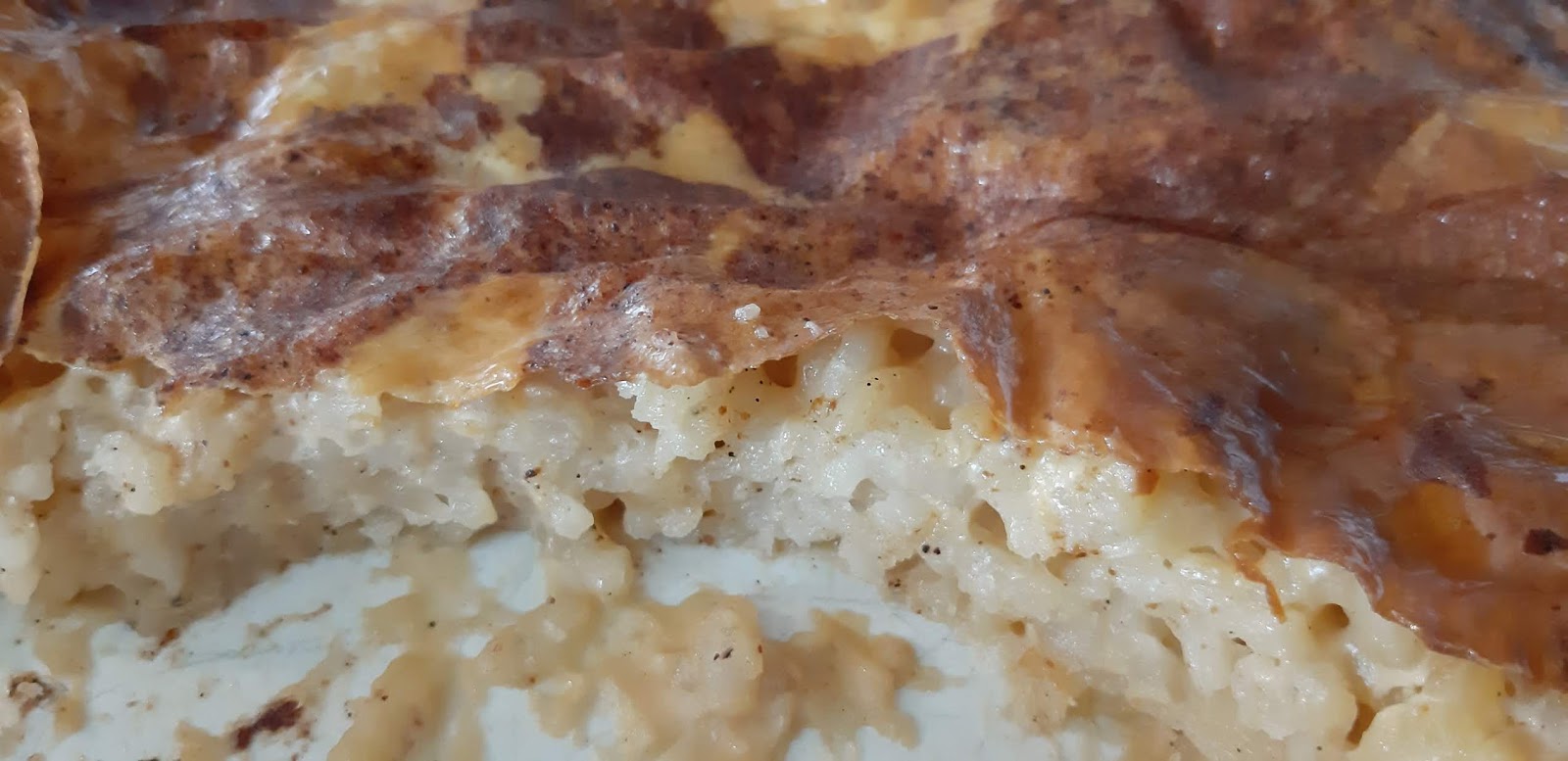
One of the abiding memories of my youth was the Sunday roast dinner and my father's party piece was his rice pudding, which he would nail week after week, and there would still be some to nibble on as late as Thursday. His recipe used evaporated milk, which gave it a creamy tang, but I make it with a few other ingredients. Every traditionally made rice pudding has that dark brown layer on top, which is ground nutmeg, and is essential to the authenticity of this most British of desserts.


Ingredients (* = optional) to make enough to fill a baking tray: 
250 g dessert (short grain) rice
1 l whole milk (3.4% fat)
250 ml full cream
1 vanilla pod
25 g to 75 g brown sugar
25 g to 75 g white sugar
1 nutmeg plus grater
* Cinnamon
* Five spice
* Some sultanas, diced apples or pears
* Some saffron
Some butter to grease the baking tray

Instructions:
Put the oven on to 150°C max, and butter a baking tray with minimum 7cm-high sides. Put the milk and cream into a saucepan and gently heat it up, making sure it doesn't boil.

Cut open the vanilla pod and scrape the contents into the pan, then throw in the pod. Once it is about to boil, remove it from the heat and let it settle for a few minutes.

While you are waiting for the mink and cream to heat up, put the rice and both sugars into the baking tray. At this point, you can also add any other of the optional ingredients. Then pour the milk and cream over the top, and give it a good stir so that it doesn't end in overcooked clumps of rice.

Grate or sprinkle as much nutmeg on the top as you want. Really, it's the most essential thing - the rice pudding without the nutmeg layer is like pasta without sauce.

Finally, put the baking tray in the oven for two hours or so (possibly half an hour longer), when the rice pudding should be soft and creamy with a splendid nutmeg roof. 

It is great both just out of the oven or cooled in the fridge. If it is done right, when it is cold, you should be able to cut slices with it, which you can serve to children in portions like sweetie bars. They love it with some jam.

Put a layer of tin foil over it, if you want to keep it in the fridge.

Apart from that, enjoy changing the ingredients slightly each time. I love the pure creaminess of a plain rice pudding, but I find cinnamon and five spice really do it for me. I also love to cover mine in brown sugar to eat.

Wednesday, 18 March 2020

Recipe CXXX - Dorset Apple Cake


One of the advantages of being holed up in a health crisis is the opportunity to do all of those things we haven't had time to do in recent times. It's been a while since I posted a recipe; this is due to a number of things: firstly, I was gravely ill a couple of years ago, then I got a huge amount of work to do, and finally I had three kids in as many years. So please excuse the lack of posts. I hope this recipe will be the first in a revival of my blog, and I would like to thank a lady with the initials AK for the inspiration.

This one is a simple but delicious recipe; Dorset, Somerset and Devon are very well known in Britain as being the home of the apple. It's where most cider makers are based, and as there are so many apples down there (there is even the town of Appledore in Devon, just to reinforce the concept), they make this lovely cake with the local produce. 

This cake is best served warm, but when cold, tastes different but no less intense.

Ingredients:
2 cooking apples, cored, peeled and chopped, then doused in the juice of half a lemon
250g of plain flour
8ml baking powder
130g cold butter, cubed
180g light brown sugar
1 beaten egg
50ml milk, possibly a little more needed later
As much cinnamon as you dare

I also added five spice, but it's not in the original recipe.

Instructions:
Preheat the oven to 180°C and grease a round cake tin with butter

Once you have dealt with the apple and lemon juice, put it aside for a few minutes while you do the rest.

Mix and sift the flour and baking powder, then throw in the butter. Mix well with your fingers until it has the consistency of breadcrumbs.

Add about four-fifths of the sugar, plus most of the cinnamon (and five spice if you like), plus the apples, then dump the egg on top, mixing thoroughly until it reaches a good homogeneous light-brown colour.

Then pour in the milk until it has a soft texture that falls slowly off a spoon.

Transfer everything to the cake tin and flatten it out. If the dough is of the right consistency, this should work almost without the aid of a utensil.

Sprinkle the rest of the sugar and some more cinnamon over the top, and put it in the oven for about 45 minutes.

When it's done, let it set in the cake tin for five to ten minutes, but not too much longer, because as I mentioned earlier, it's fantastic to eat when still warm.

It goes splendidly well with a cup of coffee - enjoy!

Monday, 23 December 2013

Recipe CXIV - The Pudding 2: Sultana, Hazelnut and Cinnamon (Sweet)

This is by no means the B-side of the pudding. The sweet pudding is utterly delicious and adorns any after-dinner table. Puddings are some of the most varied and satisfying dishes there are. This one broadly follows Recipe CXIII, but when the ingredients are added, it diverges greatly. I am once again giving you the basics; it's up to you what else you do with it.

Ingredients:
280g plain flour
80g vegetable suet, chilled and grated
50g frozen butter (but refrigerated enough so it is very hard is fine), also grated
1 egg, beaten
Some butter for greasing
Some cold water on standby, if necessary
Some whisky, rum or cognac
Cinnamon, five-spice, hazelnuts (roughly crushed as well as powdered), nutmeg, brown sugar, even honey - whatever takes your fancy


Instructions:
Put a large cauldron of water on a medium heat. Never forget to put something in the bottom so the pudding does not have direct contact with the fiery heat of the cooker. I use an upturned rice cooker base. 
Grate the butter and the suet as in the last recipe. Mix all the ingredients together in a large bowl, with your own proportions.


Knead it all together well. Add some alcohol if you want. Butter the inside of a bowl and spoon in the ingredients.


By now your water should be boiling away, so put the bowl carefully into the pan so that it is no lower than half-way inside the water. Steam for three hours.


Turn the bowl upside down onto a plate. If it is properly cooked, it should fall out immediately.


Serve with custard (here is a good recipe:http://www.bbc.co.uk/food/recipes/how_to_make_custard_82327)

Monday, 1 April 2013

Recipe XCV - Spicy Tea, Chai Masala


Chai Masala is a pretty special tea made with the most flavoursome ingredients, and in southern Asia varies from region to region, household to household. Every tea maker has his/her own way or favoured combination. The ingredients you can use range from star anise to peppercorns, and depending on the quantity, the flavour you want can be reached by adding more of one or less of another. I am making my own preference, so the ingredients below are how I like mine.


Ingredients (for 10 cups):
3 to 4 cloves
1 tsp cinnamon
15-20 green cardamoms
1 tsp ginger
15-20 black peppercorns
Water:milk ratio = 2:3
2 teaspoonfuls of tea per person
Sugar to taste

Instructions:
Put the cardamoms whole into a blender.


And the peppercorns too.


Add the other ingredients and give it a spin for a minute or two until it is pulverised. You can always use your own coffee grinder, which is very effective.


Once it is all nicely crushed, you can keep it in a jar until you need it.


Take a saucepan and fill it with the water and milk you need depending on the amount of cups you require. Put half a spoonful of your mixture per cup into the saucepan and heat until nearly boiling but not quite. Once nearly boiling, add the tea; two teaspoonfuls per cup, and don't forget to add sugar either now or once in the cup.


Simmer for 2 to 3 minutes, and then strain into the cups.


The perfect warm drink for sitting outside in the still cold spring air.

Sunday, 10 March 2013

Recipe XCII - Beef Rendang

I have a list of things I wish to do before I die. Some are probable, some definitely possible, but some are unfortunately both improbable and one is impossible, and quite frankly unspeakable and highly illegal, but such is the nature of our innermost thoughts. However, one of the things on my list is to taste all the great curries of the world, including a Thai green curry, a British tikka masala, a Jamaican goat curry, a Japanese chicken curry, a Lao curry with dill and a Malaysian rendang. But I mean I'd like to be there when I eat it. But that may take a little time and planning. I could always fly them in, but I'm sure there's only one thing better than being there eating it, and that's having it put in front of you on a plate. (Incidentally, did you know the British introduced curry to Japan?)

Anyhow, I decided to go shopping to the Asian shops in town and pick up the ingredients for a rendang and make my own version of it. It's basically everything traditionally in it, except I was unable to find the kaffir lime. But I'll add it to the list of ingredients. It was utterly worth the hard work making it, and I'd do it again tomorrow - my kitchen, indeed the street, smelled divine for most of the afternoon.

Ingredients:
600g-750g diced beef, but that's for MUCH later.

Ingredients for the paste:
80g grated fresh coconut, but the packet version will suffice if you have no access to a fresh one
1 tsp of turmeric powder
6 hot red chilis, seeded and roughly chopped (I used half a sweet pepper because they had run out of small ones)
2 tbsp coriander seeds, or the same in powder (the crushed seeds are so much better in terms of flavour though)
1 tsp of cumin seeds, or the same in powder (the same applies here too)
5 shallots or small onions, chopped enough for the mixer
50g peeled ginger, sliced up for the mixer
30g garlic, chopped for the mixer


Instructions for the paste:
Put the coconut into a large, heavy pan and roast for a couple of minutes, continually stirring, until the coconuts turn a golden-brown. Pulverise the coriander seeds and cumin in a pestle and mortar for a long time, or if you have a spice grinder, put it through that.


Put all the above ingredients, including the coconut, into a mixer and give it a really good pulping. The mixture should end up looking something like this:


Put it to one side. You are now ready to prepare the rest.

Ingredients for the rest:
About 200ml tamarind paste + water (2 parts paste, 3 parts hot water)
4 thick pieces of lemon grass - break it with a rolling pin before you put it in
2 sticks of cinnamon - break in half to release the flavour
2 cans of coconut milk
3 spoons of brown sugar
10-12 kaffir lime leaves, chopped or broken up
and the beef, of course
Feel free to add a few vegetables. I didn't, but there's nothing stopping you.


Instructions:
Take your heavy pan and put some coconut oil or vegetable oil in it. When hot, add the beef and seal.
Then put in the paste, cinnamon, lime, coconut milk and lemon grass. Once stirred in and settled, turn the heat right down to simmering level, add the tamarind paste and let it reduce for up to two hours. One and a half hours should be more than adequate. Stir very frequently.


After 90 minutes, it should have reduced.


Serve with some aromatic rice.


I think this was probably the best thing I have ever cooked, although nothing beats the real thing - one day I will get there!

Sunday, 24 February 2013

Recipe XC - Spicy Turkey Fillet Hotpot

It's still really cold here, which means more winter recipes. However this was a tremendously rewarding one, because the smell in the house is utterly divine. It is a little bit of an effort in the beginning but the main part is in a casserole dish, and for that you need absolutely nothing except a hot oven.


Equipment:
1 large sealable casserole

Ingredients:
750g-1200g turkey breast/fillet (chicken does just as well, but the pieces will remain whole or simply be halved.

Vegetables, your choice:
3 carrots, chopped
6 small or medium potatoes, cut into slices
1 red pepper, cut into strips
4-6 small onions, roughly chopped
5 cloves of garlic, sliced in two
Savoy cabbage, finely chopped into strips
1 courgette, sliced
Anything else that takes your fancy.

Spices, your choice:
1 small bowl, mix up some of the following to your own specifications:
cardamom, coriander, ginger, cumin, cinnamon, turmeric, plus some garam massala, or mild Madras.

Maximum 1.5 litres of hot, salted water

Optional:
Some coconut milk, almonds, sultanas, apples and grapes

Instructions:
Turn the oven on to 170°C. Take your turkey breast and slice it into differently-sized pieces and rub a little salt into them. Take your bowl of mixed spices and spread liberally over the pieces, saving about a third for later.


Fry them in butter or oil for five to ten minutes until sealed and place them in the casserole.
Take your onions, garlic, peppers and carrots, and give them a short period in the pan to sweat. Pour over half of the remainder of the spices and add more oil to stop the ingredients scorching. Then put this into the casserole. Add the cabbage and do the same. Mix up the vegetables making sure your meat remains at the bottom and the top is flat enough for the potato level. At this point you can place any fruit (dried or fresh) and nuts.


Finally, place your potatoes on the top to cover it all. Pour over the remainder of your spices, or add a little more to the top, to give it a brownish hue. Fill the casserole with the salted water up to the level of the potatoes but no higher, and cover it. You can add the coconut milk at this point, but it really isn't necessary as the whole thing will remain quite moist with the lid on.


Place it in the oven for between 90 minutes and 2 hours. This will give everything enough time for the flavours to run. When you remove it from the oven, leave it for a few minutes before serving.


It would go well with a nice sweet white wine.

Wednesday, 13 February 2013

Recipe LXXXIX - Puff Pastry Pies

I took a little break last week to go away for some well-needed recuperation and socialisation, so I have prepared a double-header for you this week. When talking about puff pastry, there are two ways to do it - you can either spend ages and ages rolling the stuff out until it's perfect, or you can just buy a couple of rolls from the supermarket and spend more time on the contents. Guess what I chose...

STEAK PIE
 
Ingredients
min. 450g puff pastry
450g-550g chopped beef or lamb
250ml-350ml beef stock
Carrots, roughly chopped
Mushrooms, whole, halved or quartered
Shallots, whole or halved
Cloves of garlic, sliced
Apples, in chunks
Plain flour
Thyme
Pepper & salt
Butter for frying and for greasing the pie dish
A little water for closing the pastry
1 egg for glazing the top


Instructions
Roll your meat in a bowl containing flour, salt and pepper, then put it in a high-sided pan to fry gently in the butter.


After some time, add the vegetables and continue frying for a while until it is all nice and coated in the oil of the pan. Add the thyme and garlic for a couple of minutes before you pour in the beef stock. Allow it to simmer for a good hour on a medium-low heat.


Take the meat off the cooker and allow it to cool. Grease the inside of a decent-sized pie dish. With a roll of your puff pastry, line the inside of the pie dish. Pour the meat into the middle of the pastry-lined pie dish and splash the outside with some water to help the top close properly. Take another roll and place it over the top to make a "roof". With some of the remaining pastry, make some vague decorative shapes and don't forget to pierce the pastry top a few times to let the heat escape. Glaze it with an egg and a brush.


Put it in the oven for 35-45 minutes, or until the pastry rises and goes nice and brown.


MINI APPLE PIES

Ingredients:
2 apples
Cinnamon
Brown sugar
Sultanas
1-2 cloves
A small glass of water
The rest of the egg for glazing the pastry
(a spoonful of honey - optional)
(brandy, schnapps or port wine - optional)

Instructions:
Cut up the apples and roll them in cinnamon, then put them in some water. Add some more cinnamon, followed by a clove and some sugar. Heat it up gently until it is near boiling point, then simmer it for a good half an hour, or even more. Taste it to see if it needs anything added - more sugar, or maybe a little alcohol. Let it cool down for a while.


Line some tart moulds with the remaining pastry and blind bake them for a few minutes. I didn't, as I like stodgy pastry. Put the filling into the moulds and arrange the remaining pieces of pastry on top. Glaze it with the remaining egg and sprinkle some white sugar on the top to give it some sweetness.


Bake it in the oven for 13 to 18 minutes, or until the pastry turns golden brown.

Saturday, 26 January 2013

Recipe LXXXVIII - Apple and Cinnamon Sponge Cake


This is one of the easiest and least time-consuming recipes you can find. It is perfect as an offering at a party, to sell at a village fête, or like I did, take to a celebratory end-of-semester lesson. It is very tasty, and the measurements are so easy to remember that you'll never be able to forget it.

Ingredients:
180-200g fine sugar
180-200g softened butter
180-200g self-raising flour
2 eggs
1 tbsp cinnamon
1 braeburn apple, roughly chopped

Equipment:
1 baking tin with removable base (see far left in the photo)
1 electric mixer
1 set of scales
1 large bowl


Instructions:
Turn on the oven to 180°C. Cut up your butter and put it into a bowl, then put the sugar in and mix it up. Crack the eggs, and give it a go with the mixer.


Add the flour, and carry on mixing it. It will quite quickly turn into a cement-like consistency. Then add the pieces of apple, and mix them nicely in so they are in all parts of the mixture.


Take your cake mould and grease the inside, then pour in the mix, and spread it out to make a roughly flat surface.


Put it into the oven for between 30 and 45 minutes. You will know when it is ready because a knife inserted into the top will come out clean.


Don't peel the apple - the outer layer gives the cake a tangy flavour. Serve with whipped cream and a cup of tea.


Saturday, 19 January 2013

Recipe LXXXVII - Winter Warmer: Beef Stew


It's -5°C outside and the snow lying on the ground is so charming to look at, but spend a few minutes bringing up the wood for the fire and you soon realise how nipple-hardeningly chilled you become in such a short time. For that reason, I'm making a beef stew with all the necessary accoutrements to keep the kitchen warm for a few hours - a slow oven cook. Beef shank is quite sinewy and full of marrow and fat, so cooking it in a few minutes is a very bad idea. But leave it for several hours in a casserole dish on a slow cook and the beef will do the hard work: its flavour will ooze, its fat will run, its marrow will shrink and along with the vegetables you add, the whole thing will be worth the wait at the end of the day. Bear in mind, though, you need a lot of meat to make it, as it shrinks and falls from the bone.

Ingredients:
1kg to 1.5kg beef shank
salt and pepper
2 bottles of dark beer (I used Czech Březňák because I love its smoothness, but British or Irish stout, German or Belgian dark beers will also do)
2 onions, quartered
Feel free to use your own range of vegetables. I used these below:
7 large mushrooms, whole
1 fennel, sliced
5 carrots, in large pieces
5 potatoes, cut to size, parboiled
5 cloves of garlic
1 bay leaf
6 sprigs of rosemary
10 whole peppercorns
Walnut oil, if you have it, otherwise olive oil or ordinary
Optional: sugar, cinnamon or sultanas

Required:
A high-sided frying pan
A casserole dish with a lid


Instructions:
Put the beef, well-salted and peppered, into a high-sided frying pan and fry on a gentle heat for a few minutes to seal both sides. Leave it on the side in the casserole dish. Put the water on to parboil your potatoes. Then put your vegetables, bay leaf, rosemary and peppercorns into the pan and sweat gently on a low flame for ten to fifteen minutes.


Put in your potatoes and slowly add the beer, letting it heat up to simmering point.


Leave it for a further ten minutes, then pour it over the beef in the casserole dish, and put the whole thing in the oven for 6 to 9 hours.


Not only does your house smell marvellous for a whole afternoon and evening, but the results are very rewarding.


To make the flavour just right, after a couple of hours, take it out for a brief time to add whatever it may need. This could include sweetening it, to take the bitterness of the beer away. You can use sugar and/or sultanas and/or cinnamon, but it's your call. Anyhow, enjoy the anticipation, which is just as good as the eating!


Sunday, 9 December 2012

Recipe LXXXIII - Venison Steaks in Brandy Sauce with Spätzle


German food. In terms of oxymorons, it ranks alongside French self-deprecation, Scandinavian beach resorts and beautiful Belgian scenery. What is Germany's greatest contribution to food? The hamburger? Not in the least. The schnitzel, maybe? That was stolen from the Czechs. The frankfurter, possibly? If you can find any meat in it. The apple strudel? Strong contender if it wasn't originally Czech too.

No, amongst all the stodge, the greatest contribution the Germans have made to food is their cakes. The Black Forest gâteau being exhibit number one. But amongst all the cream and fruit, there lies an alternative German cuisine that never raises its head above all the commercial stuff: their pasta. German pasta? Yep. And it's quite good. Spätzle is like short linguine, but unlike the Italian version, it can also be fried and is much more satisfying to the stomach. This recipe is one of my own, although I am sure variants exist.

Ingredients and instructions for the venison:
500g venison, cut into steaks or medaillons
2 tablespoons of cinnamon in a bowl with 4 tablespoons of flour (1:2 ratio, depending on your need)
10 peppercorns, black, ground
Salt the venison a little.


Put the flour, cinnamon and pepper into a flat bowl and mix until homogeneous.


Roll the venison in it, then set the meat aside (fridge) for a while, whilst you cut up the vegetables.


Ingredients for the sauce:
4 shallots or small onions
Some porcini mushrooms
Some whole black peppercorns
Some currants, sultanas or raisins
2 apples, diced
Some red berry confit (blackcurrant, redcurrant or something similar)
Some old-style mustard (seeds included)
Some thyme
A glass of brandy


Instructions:
Fry the steaks and onions/shallots in butter for a few minutes, then remove the meat. Add the whole peppercorns, and stir until they puff up. Then add the mushrooms, raisins and apples, and stir for a minute or two before you add the brandy, which will hiss and bubble with an aroma that should make small animals pass out, so put a lid on top and reduce the heat. About 5 minutes later, add a spoonful of mustard and confit, and some thyme. Keep on the lid and allow the liquids to run. You can put the venison steaks back on top, to integrate. Do not fear, the cinnamon exterior remains.


While that is going on, boil your spätzle. This takes between 10 and 12 minutes. Don't believe the packets in Germany which tell you to boil pasta for 2 minutes longer than necessary. Germans like soggy, runny pasta apparently.
As a nice touch, when you serve, why not put the spätzle all round the outside and fill up the middle with your sauce, putting your venison on top?


This goes well with a young, tart red wine from Navarra or northern Italy.