Pages

Showing posts with label cream. Show all posts

Tuesday, 29 December 2020

Recipe CXXXV - Fish Pie

Another staple of Christmas in various parts of Europe is the fish. In central Europe, the carp is the most common type, as it's a freshwater species and can be sourced in large quantities and bought a few days in advance. It's quite common in Czechia or Slovakia to see huge tubs of carp on market squares with customers queuing up to select their own. As they are alive, they are transported home very carefully and usually kept in the bath until its big appearance on Christmas Eve. 

It is served then because 24 December is known as Štědrý Den (Generous Day), and the last day of Advent fasting. So it was considered to be a good way of kicking off the feast, as it is a rather tasteless and boring fish, but also a more substantial meal than what they would have previously had. 

So we're not going to make our fish pie with carp; we need something with a little flavour and maybe some character. I went for cod and sea bass. For anyone who knows me, they will be astonished that I actually made a fish dish at all, let alone a salt water fish dish. 

I actually despise fish - for me the word "poisson" has one too many Ss. But every now and again I get the urge to dig into a bit of briny sauce and yesterday was one of those days. 

Ingredients:

450g-500g mixed deboned fish, e.g. haddock, cod, sea bass 

300ml-400ml milk

4 or 5 carrots, sliced

A large red onion, cut into small pieces 

20 fresh ground peppercorns 

A bunch of fresh parsley, cut up small

A couple of tablespoons of flour

As many peas as you want, and some green beans if you want 

Some white wine (optional)

8 to 10 medium-large potatoes

300g butter

200g grated cheese, e.g. Cheddar or Gruyère


Instructions:

Cut up and roll the fish in some pepper and flour; check for bones. Put the oven on 200°C. Peel the potatoes and boil them gently in salted water until soft. Mash them up with some butter and pepper. While the potatoes are boiling, put some butter in a fairly large high-sided frying pan and while it's gently heating up, add the onions, carrots, and a little flour, followed by the white wine, peas, fish and parsley. When the white wine has reduced but before the pan dries out, add the milk and cook with lid on for about 15 to 25 minutes to let the flavours run.

Take a large, high-sided baking dish and pour the fish mix in there. 


Take the mashed potato and spread evenly on the top. Some like to make little dollops with an ice cream scoop but it's not important. Put the grated cheese on top and place in the middle of the oven for 25 to 30 minutes. 

Serve immediately and enjoy!


Sunday, 27 December 2020

Recipe CXXXIV - Caramelised Brussels Sprouts and sauteed Wild Boar Medallions

It's that grey week between Christmas and New Year's Eve when very little happens except finishing up all the food you didn't gluttonously consume during the main feast days and hanging around for that great anticlimactic moment when the numbers on the clock signify that it's 1st January of the following year. But this year is different - the last week of the year of cancelled invitations and postponed bookings due to the great pestilence of 2020 will tick by more slowly than the rest of the year with the tortuous effect of a dripping tap and those leftover vegetables will have no other mouths to enter than your own, so what better way to spend a miserable December night than to make something different with your remaining food? Here's a simple but delightful take on the humble Brussels sprout, the most underestimated Christmas ingredient of them all, plus a splendid little side dish of wild boar.

Ingredients for the sprouts:

500g Brussels sprouts 

Minimum 20 fresh ground peppercorns 

100g butter 

Spoonful of nutmeg 

Some salt

Instructions:

Heat the oven to 200°C. Do the usual removal of the outer leaves, then slice the sprouts in half. Melt the butter on a low flame and pour into a wide baking dish - this is to leave plenty of room so they can sit with the insides on the base. Pour the butter into the baking dish, then cover the sprouts in salt, nutmeg and pepper before placing them flat in the butter.

Cook in the oven for 25 minutes or until soft.


Ingredients for the wild boar medallions:

350g to 500g wild boar fillet cut into slices 

Plenty of ground black peppercorns 

6 mushrooms of your choice 

1 red onion

3 cloves of garlic

A glass of brandy

150ml to 200ml fresh cream


Instructions:

Roll the boar in the pepper and some salt, cut up the mushrooms, onions and garlic. Put some butter in a wide frying pan on a medium-high temperature, fry the medallions until they are sealed, add the garlic, onions and mushrooms, pour over some brandy, let it reduce. Then add the cream and let it thicken.

Done!

I also caramelised some carrots with sugar using the same recipe as the sprouts and they went down very well. 


Monday, 30 March 2020

Recipe CXXXII - Traditional Baked Rice Pudding

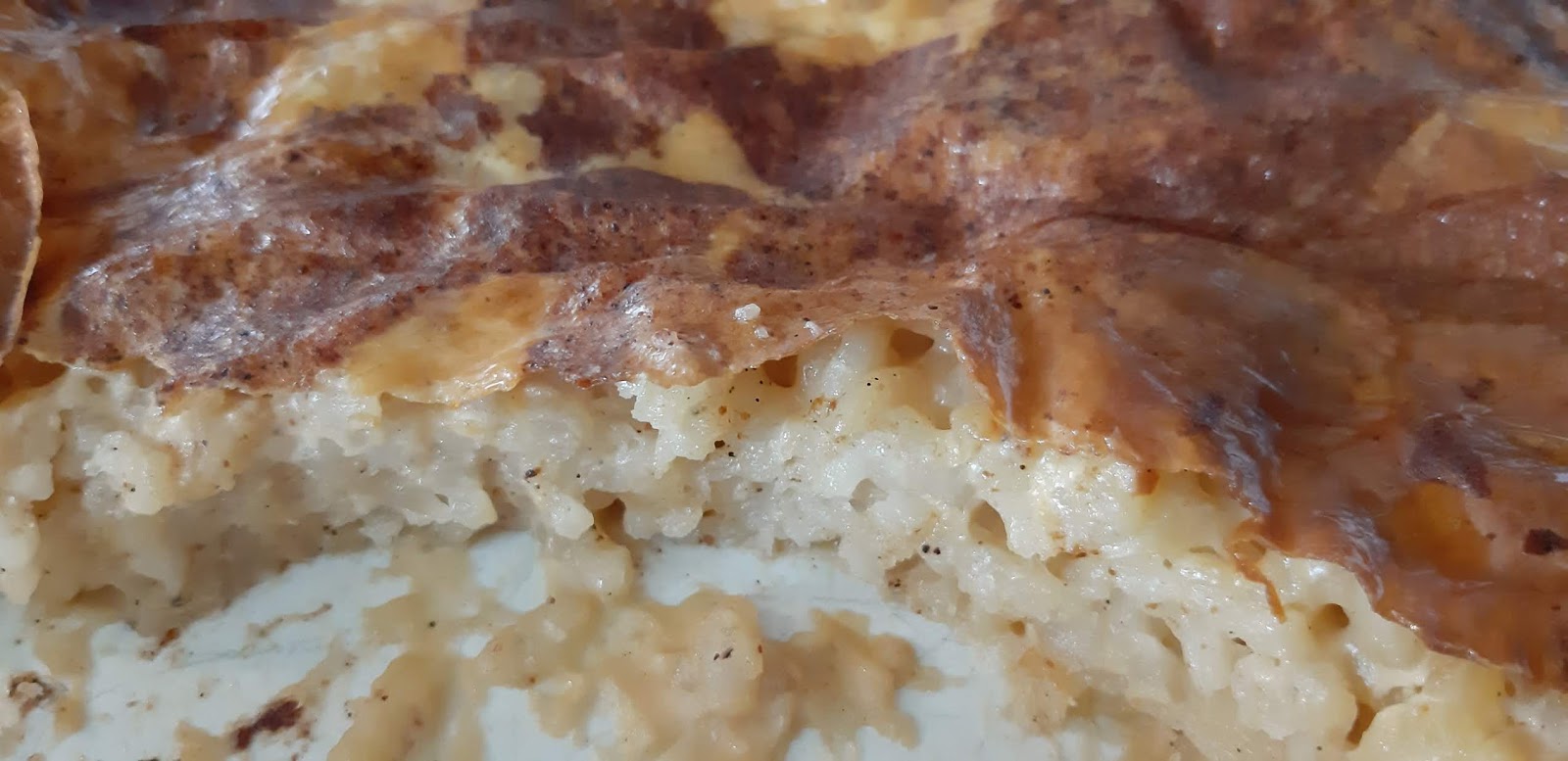
One of the abiding memories of my youth was the Sunday roast dinner and my father's party piece was his rice pudding, which he would nail week after week, and there would still be some to nibble on as late as Thursday. His recipe used evaporated milk, which gave it a creamy tang, but I make it with a few other ingredients. Every traditionally made rice pudding has that dark brown layer on top, which is ground nutmeg, and is essential to the authenticity of this most British of desserts.


Ingredients (* = optional) to make enough to fill a baking tray: 
250 g dessert (short grain) rice
1 l whole milk (3.4% fat)
250 ml full cream
1 vanilla pod
25 g to 75 g brown sugar
25 g to 75 g white sugar
1 nutmeg plus grater
* Cinnamon
* Five spice
* Some sultanas, diced apples or pears
* Some saffron
Some butter to grease the baking tray

Instructions:
Put the oven on to 150°C max, and butter a baking tray with minimum 7cm-high sides. Put the milk and cream into a saucepan and gently heat it up, making sure it doesn't boil.

Cut open the vanilla pod and scrape the contents into the pan, then throw in the pod. Once it is about to boil, remove it from the heat and let it settle for a few minutes.

While you are waiting for the mink and cream to heat up, put the rice and both sugars into the baking tray. At this point, you can also add any other of the optional ingredients. Then pour the milk and cream over the top, and give it a good stir so that it doesn't end in overcooked clumps of rice.

Grate or sprinkle as much nutmeg on the top as you want. Really, it's the most essential thing - the rice pudding without the nutmeg layer is like pasta without sauce.

Finally, put the baking tray in the oven for two hours or so (possibly half an hour longer), when the rice pudding should be soft and creamy with a splendid nutmeg roof. 

It is great both just out of the oven or cooled in the fridge. If it is done right, when it is cold, you should be able to cut slices with it, which you can serve to children in portions like sweetie bars. They love it with some jam.

Put a layer of tin foil over it, if you want to keep it in the fridge.

Apart from that, enjoy changing the ingredients slightly each time. I love the pure creaminess of a plain rice pudding, but I find cinnamon and five spice really do it for me. I also love to cover mine in brown sugar to eat.

Monday, 7 July 2014

Recipe CXVIII - Panna Cotta with Raspberry Jelly Topping

This recipe is so easy although it takes a little time - not yours, however, its own time in the fridge. It's another spinoff of the trifle, this time from Italy. The Italians took a lot from English cuisine several hundred years ago, but changed the look drastically, which is why English desserts look decadent and sumptuous, and Italian ones look like a keyhole surgeon has found an entertaining way of using his/her tools in the kitchen on days off. So here is another one, to follow the last recipe...

Ingredients for the panna cotta:
Half of a 9g packet of gelatine
500g cream
25g fine sugar
1 vanilla pod, cut down the middle with the insides scraped out


Ingredients for the jelly topping
Some cherry or raspberry genever 
4 suitable glasses
200cl water
200g raspberries
The other half of the 9g packet of gelatine
100g sugar 
A blender


Instructions:
Put the sugar, gelatine, vanilla and cream into a non-stick pan and heat gently, making sure it never bubbles up. It is essential that it goes no further than simmering, as it will detract from the final result. Make sure all the gelatine and sugar has been melted.

I'm not going to insult you by showing you a photo of this process, so let's move on.

When everything has nicely dissolved, pour the mixture out equally into four suitable glasses. Put some clingfilm over them and leave them to cool. Then put them for at least an hour in the fridge.

In this time, you can make the jelly.

Put the genever, water and sugar into a pan and slowly heat. Do not allow it to boil if you want a more alcoholic taste to the jelly. Once fairly hot, put in the gelatine and allow everything to dissolve. Then put in the raspberries and pour everything into a blender. 

Put it back on the heat for a minute or two, and then leave it to cool, but not fully or you won't be able to pour it onto the panna cotta.

But once it's tepid, get it out and pour over the panna cotta.


Put them back in the fridge and serve when ready.

Wednesday, 5 February 2014

Recipe CXV - Gentse Waterzooi

I'm back. Sorry I was away for such a long time - I have been incredibly stressed, and cooking had become a necessity rather than a pleasure. But I'm returning with this incredibly easy and remarkably tasty Belgian dish from the city of Ghent. French, as well as Belgian food, relies heavily on the use of butter in preparation. This is no different and adds most deliciously to the overall flavour. It takes relatively little effort and will make you smile when you put it in your mouth.

Ingredients:
One leek
Two tablespoons butter
Two carrots, peeled and diced
Four medium-sized potatoes, peeled and quartered
Salt and freshly ground pepper (usually white, but I used black)
1 litre of chicken stock or hot, salted water if none available
Two fresh bay leaves
Three sprigs of fresh parsley,
Three sprigs of chopped parsley to garnish later
Three sprigs of fresh thyme
Two large boneless, skinless chicken breasts, cut into large chunks
Half a litre of pouring cream
1 large egg yolk
Some crusty bread (e.g. baguette) for dipping


Instructions:
Melt the butter in a high-sided frying pan on a medium heat. Sauté the vegetables until they are soft, putting in some salt and pepper.


Put in the sprig of parsley, thyme and the bay leaves, and then add the potatoes and most essentially the stock or the hot water. You normally need chicken stock, but because you are about to add pieces of raw chicken to poach in the liquid, hot water straight from the kettle with some more salt should do the trick in an emergency.

So when you have added the liquid, put in the pieces of chicken and cover and poach for 10 to 20 minutes. It may look like a mess right now, but soon it is going to transform itself into something unbelievable...


Take a pouring jug, siphon off an egg yolk and add the cream. Stir them well. Take a little of the hot liquid from the pan so as not to shock it when it goes into the pan itself. Pour it in, add the chopped parsley and watch it become so incredibly tempting. Don't wait for too long before serving!

Although the photo doesn't do it justice, I have to admit...


Serve it in large bowls with some fresh bread.

Sunday, 24 November 2013

Recipe CXI - Veal Steak Strips with a Leek and Blue Cheese Sauce

That's not the full title, but on the Net one is supposed to be brief... The full recipe would be "Veal Steak Strips and Caramelised Onions on a Bed of Spiral Pasta in a Leek and Blue Cheese Sauce", but that would just look too unwieldy...

Anyhow, this recipe is perfect for a cold November evening when the nights are getting longer and the memories of summer are still not so far away. 

Ingredients:
A third of a leek, cut into tiny pieces
100g Roquefort, Stilton, Gorgonzola or some such blue cheese
1 or 2 onions, thinly sliced
200ml cream
400g pasta, preferably large
Some small veal steaks, sliced into strips
Ground black pepper
Lots of butter for frying


Instructions:
Put butter into a saucepan and a decent frying pan, and water into another saucepan. Switch all of them on medium except the water (high).
Put the steaks in the frying pan and add a tiny bit of salt. Fry gently, removing any leakages from the meat. Put the onions in towards the beginning.
Take the leek and pulse it in the mixer for a while until it is in small pieces. Fry gently in butter.
Put the pasta in salted boiling water.


With 5 to 10 minutes before the pasta is ready, put the blue cheese in with the leek. Allow it to melt, then add some cream and let it heat on a gentle temperature without bubbling.


Once the pasta is cooked, the rest should be ready too. 


When dishing up, think about making it presentable. I mixed the sauce with the pasta, put the meat on top in a small pile and the onions on top. But I'm sure you'll have a method that is just as attractive! Finish off with some rocket salad or such like to give it some colour.

I like my steaks nicely browned on the outside and red on the inside, hence the contrasting shades.

Sunday, 15 September 2013

Recipe CVIII - Cheese, Leek & Bacon Quiche

So, how long does it take me to write up a recipe? All week, actually; sometimes longer, depending if I have thought of something to do or not. Which is why I don't post every week any more - I do a lot of experimenting and some weeks I don't think it's good enough to post. Anyhow, I'd say it takes up to 5 days for a recipe to ferment in my head, about 2 hours shopping (sometimes more, if I have to go to a city for ingredients), and most of the afternoon making it, taking photos that don't reveal the chaos that is my kitchen, but then a good hour to upload photos and type up the recipe on here. So I hope you appreciate this one - I have to say it's one of my top ten, and I thoroughly enjoyed eating it after!


Ingredients:

For the pastry:
220g of plain flour, sifted
a pinch of salt
130g butter, chilled and cubed
1 medium-sized egg, beaten
A roll of clingfilm
Some baking beans for blind baking

For the filling:
You can make up your own, but here are mine:
200g bacon lardons, finely chopped
60g fresh cheese (I used the French sheep's cheese Brébiou but Cheddar, Manchego, Mahon, Pecorino, even Stilton would all be fine - just taste a couple at the cheese counter and take one)
1 onion, 1 leek, 3 spring onions, 3 cloves of garlic, (some courgette, optional), chopped
Some chives (optional)
3 eggs
200ml double cream
100ml single cream
Some fresh herbs
salt and freshly ground black pepper

Instructions:
Heat the oven to 180°C and grease your pastry tin.
Make some pastry by putting the flour, butter, fresh from the fridge, or it won't work, and the beaten egg together and kneading it into a crumbly dough. Alternatively, put it in the mixer and pulse. Then wrap it up in clingfilm and let it prove for 30 to 40 minutes.

Afterwards, spread clingfilm on the countertop, put more on top of the pastry and roll it out until it is as wide as your baking tray. Put the pastry inside carefully and cut off the excess. Fill it with baking beans and blind bake it for about 20 minutes.


In the meantime, cut up all your vegetables and cheese into blocks, fry the bacon (bit of black pepper too), then remove and put on some kitchen tissue to drain the oil; do the same with the other vegetables. Then take the creams and eggs and mix them together to make a consistent gloop. Put the other ingredients in there, and spread them about until there are no clumps of one particular ingredient. 

Remove the pastry from the oven and let it cool so you can remove the beans. It should be quite hard now, so that when you spoon the creamy gloop into it, the base remains unaffected by getting wet.


Put the whole into the oven for between 30 and 45 minutes - mine needed 40. Make sure the quiche is cooked through by putting a knife into the middle. If it comes out clean, it's done. If not, put it back for more time.


I like to keep the cheese bits a little bigger than normal, as it makes the pleasurable experience of eating melted cheese as real as possible.


Friday, 16 August 2013

Recipe CV - Chicken Breast in Creamy Bacon and Mushroom Sauce

Sorry for the recent lack of posts - I've had quite a lot to do recently renovating the house, painting and whatnot, and then there's the little matter of work. But now I have a dry run through to October, so I hope to pick up a little more momentum...

This recipe is so easy and a real crowd pleaser, going really well alongside the rocket salad recipe of last time. I bought a metallic frying pan last year specifically for meats. One of those that gets rustier the longer you use them. They cook meat really well and I couldn't ever imagine not using one for this type of dinner. 

Ingredients:
2 to 4 chicken breasts
Some thinly diced bacon
An onion
Some sliced mushrooms
Some cream
Some black peppercorns
Some Italian pasta or Greek krithiraki, potatoes or rice
*no salt!!!


Instructions:
Slice the chicken breast exactly as you like it. I prefer large pieces for this, but there is something to be said for fork-sized pieces. Fry the chicken breast in a little olive oil. Keep turning and pressing all the time. Season the chicken with some of the pepper. Add the bacon and onions for about five minutes before transferring them to their own pan.


Add the mushrooms and a little more pepper. After some time you will need to add the cream. Do you want to reduce the sauce? Put it in early. Do you want to have a lot of cream? Put it in 5-10 minutes before serving.


In the meantime, boil the pasta, and keep turning the chicken!!
To present, this is the perfect recipe to think about ways of making the dish attractive and appetising. I like to serve the sauce in a round mini-bowl on the plate, so people can make up their minds where to pour it. Some like it on their meat, some on their side dishes, me all over...


The sauce is salty enough, so don't worry about that. It is just the base - do some experimenting: you could also add ground or whole green peppercorns, white wine or so many other things to it.

Sunday, 19 May 2013

Recipe XCIX - Apple-Vanilla-Mascarpone Dessert


I'm now on my 99th recipe. This has been a fabulous adventure for me to attempt to cook a different meal at least once a fortnight, but on average every eight or nine days. This one is so easy and yet fulfilling to make and a remarkable crowd-pleaser. You need a good hour for this, but it'll be worth it.

Ingredients:
5 apples
2 tablespoons of brown sugar (approx)
4 tablespoons of white sugar (approx)
1 carton of ordinary dessert cream
1 tub of mascarpone
3 eggs
2 vanilla pods
A handful of speculoos biscuits but shortcrust will do
A spoonful of cinnamon

Equipment:
An electric whisk
A blender


Instructions:
Cut up the apples and put them in water and tip some brown sugar over them. Some remove the skins, but I leave them on as I like a nice zesty tang to my apple purée.


Put the biscuits in a blender and give them a whiz until they're pulverised. Put them aside until later.


Take the cream, eggs and mascarpone and fold them into each other. Add the white sugar (to your own tastes) and empty the vanilla pods into it by cutting down the centre from one end to the other and scooping the vanilla out with a teaspoon. Then get the electric whisk and turn it into a creamy substance.


Meanwhile, get half the apples and scoop them out of the water and into a blender. Whiz it up until it turns to pulp. Put them in a bowl to cool.


With the other half, add some cinnamon and blend it to a pulp. So below you see the difference. The one on the right I am saving for my roast pork later, and the one on the left is going further in this story. Put it in the fridge for a while first though.


Spoon very carefully some apple purée into the bottom of a glass and smooth it down to a flat surface either with a spoon, or by gently swirling the glass. Add the mascarpone layer after this, and then the biscuit crumbs.


Use various sizes of glass depending on who they are intended for.


You can do the same thing with other fruits, such as raspberries, pineapple or blackcurrants. The vanilla would be an unnecessary, depending what you choose.

Monday, 18 March 2013

Recipe XCIII - Carrot and Ginger Purée

This week, we're doing something nice and simple to go with your average meal. I have never seen the reason why people seem to boil the living daylights out of vegetables and serve them as they are, except hot, soggy and bland, especially for kids. You can steam them, fry them, roast them, pickle them, eat them raw or even barbecue them. But if you are going to boil them, at least make them interesting... This one is so simple, yet is really delicious, and the ingredients you wish to use are flexible. The timing is the most important.

Ingredients:
10 medium-sized carrots, or 6 large ones
A teaspoonful of ginger
A teaspoonful of sugar
Some garlic (optional)
Some onions (optional)
A spoonful of butter
10cl cream (optional)
Some Savoy cabbage (optional)
Some new potatoes (optional)
Some chives, chopped (optional)
Some meat - pork cutlets, for example


Instructions:
Cut up your carrots and place them in some lightly-salted water, putting the new potatoes on top to steam and not forgetting to put the lid on.

All this time, you can be gently frying the meat and the Savoy cabbage (See recipe LXXXV). If you just want simple savoy cabbage, fry it in a little butter and olive oil, then once sweated add about 1.5 centimetres of hot water. Salt it and let it reduce on a medium-low heat.


Once the carrots are properly boiled (25 minutes should do it), place them in a mixer. At this point you can quickly sweat an onion and a couple of cloves of garlic and put them in, but it is not essential. Add some sugar, some butter, some ground pepper and powdered ginger. Some chives are also welcome.


Blend them well, and add some cream if you prefer it that way.


While they are still hot, put some butter on the potatoes and the chives.


Serve as soon as possible before everything gets too cool.

Sunday, 16 September 2012

Recipe LXXII - Chicken Clare Balding

This is a recipe I designed myself with very careful thought. I wanted to honour the person who most epitomised my wonderful summer of sport on TV and my time in London during the Games. This person is, for me, someone who straddles classes, who is at home sitting next to other presenters and pundits in the studio, interviewing an elated tongue-tied competitor or mingling with crowds inside and outside venues. She explains everything so clearly and is most obviously hyper-intelligent without having any airs or graces. She is also one of those who is on my list of living people I'd most like to invite to a dinner party. I hope she gets to read this recipe one day and if she makes it, that she likes it. I apologise for the three horrid photos, but I have a new light in the kitchen and it is somewhat over-bearing for my poor little camera... Just like Clare Balding, this is an extremely adaptable recipe for the season, the taste and the consistency, but below are the original ingredients I used, the essential items having asterisks (*).


Ingredients (for 2 people):
200g Greek krithiraki / manéstra pasta * (an Olympic commentator should have something Greek in her eponymous recipe, although I used Turkish as that's what they sell locally!)
Half a courgette
Half a pâtisson (yellow squash or in the US pattypan squash) *
(in different seasons I see no problem in using sweet potatoes, aubergines or the like to add seasonal taste)
1 sweet red pepper *
1 onion
1 spoonful of chili powder *
2 breasts of chicken (sliced into strips) *
(A handful of green beans is a pleasant variant)
1 carton of single cream *
Some olive oil *
3 sprigs of English garden mint *


Instructions:
I think it was a pleasure to make this dish. Slice the squash into thin strips. You can halve those strips or keep them the same size, but they should be no thicker than a third of a centimetre. Cut up the chicken breasts into chunky pieces. Slice the courgette, pepper and onion in any way you wish.
Take two frying pans, on a medium heat, with olive oil - in one, begin frying the chicken, in the other, the squash. In the one with the squash, add some chili powder, and in the other once the chicken is sealed, add the vegetables. Stir-fry both pans, the squash for a good ten minutes. Add the chopped mint to the squash after seven, and in the other pan stir-fry the chicken for up to half an hour, or until everything is nice and soft and the flavours have run.


Once it is cooked, add the squash to the chicken for the remainder of the cooking time, and with ten minutes to go, turn down the heat and add the cream to gently heat up without evaporating. While the other ring is hot, heat some salted water and cook your Greek pasta. You can either mix it in with the other ingredients once cooked, or as I did, serve the chicken on a bed of pasta.


Above is one I made with green beans.

Serve in wide bowls or flat plates, with a nice bottle of medium Kent, Sussex or Hampshire wine.


My person of 2012, Clare Balding - photo: www.tvnewsroom.co.uk

Tuesday, 10 July 2012

Recipe LXV - Tiramisù

Tiramisù is probably the world's most mis-managed dessert. Some are really, really good, and some are very, very poor imitations. I, for example, hate it being too spongey as the cook thinks it a good idea to pour litres of alcohol over it. I prefer separating the alcohol from the sponge by putting it into the cream, and letting the coffee be the hero at the bottom. "Tirami Sù" is Italian for "Pick me up", and it is exactly that. After the main course, a hit of cream, coffee and alcohol is precisely the antedote required to round off a delicious meal.


Ingredients:
1 cup of strong, cold coffee
25-30 Boudoir biscuits
250g Mascarpone (I only used one of these in the end!)
A cup or more of cream
A cup of sugar
Some alcohol - I prefer my own (see recipe XIII)
Two glass bowls (large and small, at least one square)
A grater
Some chocolate to grate on top


Instructions:
Take the cream and put it in a bowl. Whisk it until it is fluffy and small peaks appear on top. In another bowl, put in the Mascarpone, alcohol and sugar. Fold it all in together.
Then fold the Mascarpone mix into the cream until it is consistent.


Put a layer of Boudoir biscuits on the bottom of the square bowl, and drizzle some coffee over it.


Spoon a layer of your creamy mixture over the biscuits, then flatten it down.


Repeat another layer with more Boudoir biscuits and some coffee, and put more creamy mix on top.


Take the grater, and with the fine edge, grate a layer's worth of chocolate on to a plate. Put the chocolate aside for later.*


Use the edge of the plate to sprinkle the grated chocolate on top of the Tiramisu.


Put it into the fridge until serving time.

*A little extra something for the kids:
Don't waste the left-over ingredients! As the Tiramisu has alcohol in it, you can take the smaller bowl and do something with the rest for any children. As long as their dessert is jam packed full of chocolate, there's little or no chance they'll want some of yours...
Break the remaining Boudoir biscuits into the bowl. Melt the chocolate on a low flame, and tip it into the rest of the cream mixture. You can either stir it in, or make some swirly pattern out of it.